
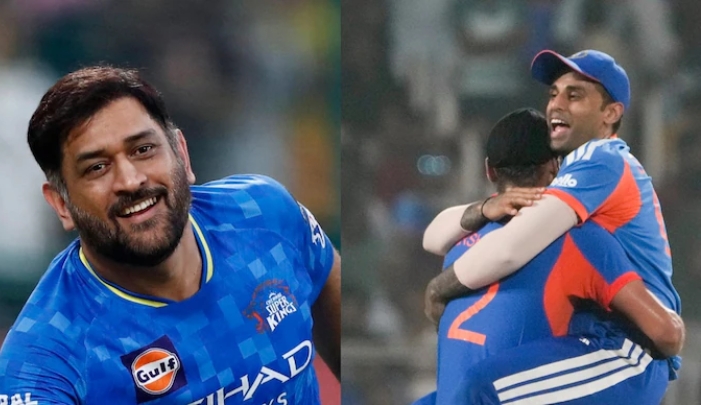
A former India captain Mahendra Singh Dhoni has given a strong affirmation of his team’s Indian cricket team’s chances prior to the ICC Men’s T20 World Cup 2026 and described the team as “one of the most dangerous teams” during the tournament, while also warning that dew conditions can play a significant influence on how games play out.
At a press conference in the lead-up to the tournament, Dhoni — who was the captain of India to its first T20 World Cup title in 2007. And expressed his confidence that the present Indian team has the proper mix of talent with experience, knowledge, and the ability to be a formidable contender in the world’s most prestigious event. India are the current champions, having won the title in 2007 and boasting a remarkable current record of T20 internationals.
The campaign for India begins with a group A match with the United States at Mumbai’s iconic Wankhede Stadium on February 7, which will be India’s first game at home during the tournament. As hosts and reigning title holders expectation from both the public and even pundits are very high.
Dhoni Highlights India’s Strengths
Dhoni stressed that the team has a well-rounded player across all areas. According to Dhoni, India’s batting lineup that is well-known for its power and depth, along with a diverse bowling attack with top performers provides them with a advantage in a speedy format. “What all is needed in a good team, everything is there,” Dhoni stated, highlighting the knowledge of the team.
He emphasized that many Indian players have been put under stress in high-risk situations which he believes is crucial for T20 cricket. “They are experienced, and especially in this particular format. Their experiences are vast. They’ve performed under stress,” he remarked, saying that team’s mental strength might be as crucial as their technical skills.
Unpredictability of the Format
Despite his faith, Dhoni was careful not to “jinx” India’s prospects by making definite predictions. He acknowledged the unpredictability that is T20 cricket, in which matches can be based on tiny moments or even the best teams may be beaten in the course of their game. “The problem is when some of your players have a day off and somebody from the opposition has a brilliant day. It can happen in T20 cricket,” He said, pointing out the small margins that can determine the outcome of a contest.
To demonstrate this Dhoni pointed out that in a set of ten games against top-quality opponents, a consistently good team is likely to be more likely to win in neutral conditions. But, the inherent volatility of games that are quick format means that the form as well as fitness and performance in any given game are the most important factors.
Dew: A Tactical Factor
One of the main issues Dhoni identified prior to the tournament was dew particularly in the evening matches. Dew is known to significantly alter the playing conditions by favoring the team who is chasing in the match, making grip and control a struggle for bowlers. This is a factor that has been highlighted by players as well as analysts as a significant factor when it comes to limited-overs cricket in India. Indian subcontinent. Dhoni said that dew is a factor is something that “changes a lot of things,” highlighting the impact it can have on the game, particularly when it comes to the toss.
India’s Recent Form and Credentials
India’s chances of winning 2026’s T20 World Cup 2026 are good. After having won the tournament in 2024, both the United States and West Indies, India have maintained an impressive performance through multi-nation and bilateral series, winning without a doubt at major events. They have shown reliability and strength-hitting abilities that distinguish them from other teams.
These performances have strengthened the reputation of India as a favorite for the title, which is which is shared by commentators and former players who are not part of Dhoni’s analysis. The former Australia player Michael Klinger, for instance recently commented that India’s explosive performance and batting are “extremely difficult to beat” during the forthcoming World Cup.
Broader Context Ahead of Tournament
The T20 World Cup 2026, scheduled for February 7 through March 8 in venues in India as well as Sri Lanka, will include cricketing powerhouses as well as emerging teams, offering an atmosphere of excitement and balanced competition. The event has also been marked by off-field issues, such as tensions over scheduling and diplomatic relations between the boards of cricket, particularly in the case of India as well as Pakistan. The political decisions regarding match participation caused a flurry of reactions from spectators and stakeholders, creating an uncertain context to what’s anticipated to be an unforgettable sporting spectacle.
The schedule for India’s group stage and the knockout draws that follow can test their team’s flexibility depth, resilience, and flexibility. Beyond the marquee battles and tactical considerations such as playing conditions, pitch behavior, and match day weather will likely impact the outcome. Dhoni’s comments reflect an understanding of both the strengths in the Indian team and the factors that will affect how they go about their T20 World Cup journey.
As the timer for the tournament approaches the focus will be focused on India to determine if they are able to convert their formidable team with home advantages into continued success on the world’s most prestigious T20 stage.