
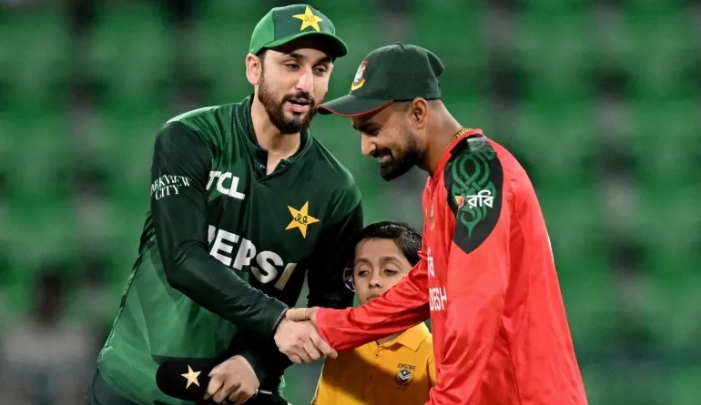
The government of Pakistan has announced that the Pakistani national men’s cricket squad will not play to play India for the stage group of the ICC Men’s T20 World Cup 2026 the decision was framed as a gesture to show solidarity Bangladesh after its exclusion of the event. The high-profile match will be played on the 15th of February on the 15th of February in Colombo, Sri Lanka the place where Pakistan’s team is based for this tournament.
In a broadcast speech to the federal cabinet at Islamabad, Prime Minister Shehbaz Sharif declared that Pakistan has taken an “very clear stand” on the issue and stated that the decision was made to keep politics out of the sport but at the same time he supported Bangladesh’s position. “We have taken a very clear stand on the T20 World Cup that we won’t play the match against India because there should be no politics on the sports field,” Sharif declared, calling the boycott”an “appropriate decision.”
Sharif said that the decision of the government was carefully thought out and based on meticulous deliberation at the top levels, making it an act of principle and strategic. “We have taken a highly thoughtful stance and must fully support Bangladesh I believe this is an extremely appropriate decision. We are united with Bangladesh,” he added.
Background to the Boycott
The protest is a result of a number of controversies concerning the T20 World Cup, which hosts India along with Sri Lanka and runs from February 7 through March 8 2026. Bangladesh was excluded from the tournament when Bangladesh Cricket Board (BCB) Bangladesh Cricket Board (BCB) refused to send its team to India for scheduled matches in the event of the security issues. Security concerns were the reason for Bangladesh’s exclusion. International Cricket Council (ICC) later changed the status of Bangladesh by Scotland in an action that was met with protests from both the Pakistan government as well as the Pakistan Cricket Board (PCB).
The PCB is headed by chairman Mohsin Naqvi, who also serves as the interior minister of Pakistan–has voiced a strong objection towards the verdict, calling the decision as a sign the use of “double standards” by the ICC. Pakistani officials highlighted apparent differences in the way the issue of safety and venue is dealt with for the various member nations.
Government Stance and Justification
Sharif’s remarks Sharif explained the decision as being a protest against what Islamabad considers to be a the politicization of cricket. He emphasized that the country has made its decision “after careful deliberation” and said that the decision was both appropriate and appropriate given the current circumstances. Although Sharif was not explicit in his remarks to connect the decision to a specific incident, his remarks strengthened Islamabad’s belief that cricket must be unaffected by political tensions, and he also endorsed Bangladesh’s concerns.
The official announcement of the government initially released in February 1 on their social media outlets said that although the Pakistan team was expected to participate in the entire tournament however, it will not take the field in the scheduled match against India. The announcement at the time didn’t explain the reasons behind this decision, which left room for speculation after Sharif’s cabinet announcements.
International and Regional Responses
The ICC expressed its concern about Pakistan’s sporadic participation, stating the fact that “selective participation undermines the spirit and sanctity of global sporting competitions.” The body that governs the sport has asked PCB PCB to reconsider its decision, highlighting the possibility of future consequences for everyone affected.
Despite the ICC’s cautionary words that the ICC has issued, many voices in Bangladesh supported Pakistan’s decision. Bangladesh Youth and Sports Adviser Asif Nazrul publicly expressed his gratitude to Pakistan for its decision to boycott the country as a show of support in the ongoing dispute regarding Bangladesh’s exclusion from games being played in India. “Thank you, Pakistan,” Nazrul posted on social media in a post.
Cricketing Implications
The decision has important implications for the tournament’s competition environment and its commercial potential. The India-Pakistan match is widely considered to be one of the most anticipated cricket matches, attracting huge viewers and interest from sponsors. The cancellation of the fixture is likely to affect rights for media as well as the revenue from advertising associated with the game.
On the domestic front, a decision to cancel the game will result in Pakistan 2 points on the standings of the group stage which will reduce its chance of advancement depending on the performance. It is also unclear the impact of the boycott on possible knockout-stage scenarios as well as the possibility that Pakistan would play in a possible India match later during the tournament.
Wider Context of India-Pakistan Cricket Relations
The decision is a result of long-standing tensions in the cricket relationship between India and Pakistan and Pakistan, the two countries being unable to play a formal bilateral series in more than a decade due to tensions over politics. Venues that are neutral, such as Sri Lanka, have been used to facilitate games which involve both countries during multi-nation sporting events.
The ongoing standoff adds yet another chapter to this complicated relationship, which illustrates how geopolitical tensions could spill over into the sports arena, and impact participation at the top level of cricket in the world.
Ongoing Developments
As the tournament continues, all stakeholders, such as players, the ICC, PCB, and hosts will be keeping an eye on the situation carefully. The possibility of negotiations or appeals, as well as diplomatic intervention is still unclear and has implications for the governance of cricket as well as the relationship between regional sports organizations.
Note This coverage is based on reports and official statements on February 5 2026.