
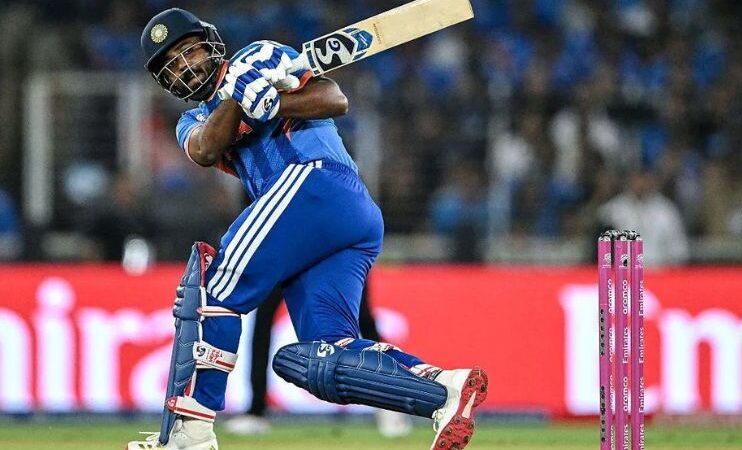
Sanju Samson delivered the defining performance of his career in international cricket when India defeat New Zealand by 96 runs in the T20 World Cup final in Ahmedabad on Sunday. The Indians secured their place in the tournament with a fervent victory. In a tournament in which it was not anticipated at first to play a significant part, the 31-year-old wicketkeeper was voted the best player in the tournament and was a key player in India’s winning campaign.
Samson recorded 89 in the last match, helping India to a dominant score in the match against New Zealand in front of an enthusiastic crowd. Despite his remarkable performance winning the prize for the best player of the match was given to the speedy bowler Jasprit Bumrah. His disciplined bowling skills helped to limit the opposition, and secure India’s win.
The award choice expressed the sentiments of Samson earlier during the tournament. In the semifinal game against the England national cricket team Samson was named”Player of the Match” for having scored 89 runs, a figure that was similar to his performance during the championship. In the midst of this, he claimed that Bumrah was deserving of the award rather than.
“All the credit belongs at the feet of Bumrah,” Samson said following his semifinal win. “This ought to go to him Actually. If he hadn’t bowled in this manner during the dying overs, I’d not be here today.”
Samson’s comments highlighted the significance the bowling team of India played to the team’s performance. But, his contribution as a bat player were important in ensuring India made it through the tournament, and eventually made it to the final.
One of Samson’s best matches came earlier in the tournament in the final Super Eights match against the West Indies cricket team in Kolkata. The match effectively functioned as a knockout match and both teams vying for to make it into the semifinals.
In that match, Samson produced an unbeaten hundred, which anchored his team to the Indian innings and helping players to an respectable total. The performance stood out not due to the sheer power, but for its technical skill. Samson was able to rely on his balanced feet, steady positioning at the crease, and meticulous choice of shots, not aggressive ingenuity.
His style of batting has long been considered to be classic compared with the modern power-hitting technique which dominates Twenty20 cricket. Samson keeps a traditional stance and refrains from excessive movements around the crease, preferring to use strokes that look like traditional cricket shots. Many observers noticed that even his most powerful hit retained the style and form that is associated with traditional cricket.
As a wicketkeeper-batter Samson is also responsible for a large work load at the field. His job behind the stumps is one that requires constant focus and physical strength throughout the course of a match. Team members and analysts have often praised his fitness and dedication to work, which he has cultivated through years of training and national tournaments.
Although Samson’s performances in recent times have been a source of attention however the international experience of Samson has been marred by a long period of inconsistency and little opportunities. Samson made his debut for India in the year 2015, still just a teenager, following his rise to recognition via his participation in the Indian Premier League.
In the early days of his career Samson was widely recognized as a promising talent especially for his work as a player for his Rajasthan Royals franchise. However, transferring his success onto the international stage was a challenge.
In his initial 23 innings in India during Twenty20 Internationals Samson was able to score only a half century. Despite his status as a gifted player however, consistently good results at the most elite levels were not attainable. However, he continued to use the same method of technical method that brought him success in cricket at home.
The majority of Samson’s progress was done outside of his spotlight at international events. Samson played for a long time on India’s domestic circuit, especially during the Ranji Trophy, where he developed his abilities and developed his experience. The matches, played mainly in stadiums that were not well-known were a vital component of his education in cricket.
Teammates and coaches have often been able to point to the domestic seasons as the basis of Samson’s grit. The lengthy period of training, traveling and competition shaped his disciplined attitude and perseverance.
In the time prior to the actual T20 World Cup, Samson had to overcome additional hurdles to secure a regular spot in the national team. Many young players fought for places on the batsman’s list and inconsistent performances in bilateral matches led to Samson often was not a favorite with the selectors.
In the lead-up to this tournament, the player wasn’t thought to be a sure-fire player in India’s playing team. However, the situation within the squad gave him an occasion. Samson was given the opportunity to play as an opener in an effort to ease the pressure placed on new batter Abhishek Sharma, who struggled to find his form at the highest of the order.
Another factor also affected the team’s decision-making process. Middle order batter Rinku Singh resigned from the team in the course of play to care for his father’s ill health, creating spots in the lineup, increasing the chances that Samson will play.
When he was given the chance, Samson capitalised on it. Through the course of the tournament, he recorded 321 runs, with an average strike rate of 200 which makes Samson among the most efficient batters in the tournament. His contribution included a number of powerful innings which assisted India retain momentum throughout the knockout and group stage rounds.
The format of the tournament and its intensity frequently reward aggressive batting which is why players are willing to take risks to score quickly. Samson’s style of play was in line with this principle, which emphasized impactful innings instead of the slow the accumulation of scores.
The observers noted that Samson did not change significantly his style of batting during the tournament. He continued to follow the same batting focus that was the hallmark of his previous career. According to experts is that his performance ultimately produced results that were consistent.
The management of the Indian team also emphasized an approach that promoted high-risk and high-reward batting. In this environment, Samson appeared comfortable and confident, which helped contribute to the team’s aggressive stance.
At the point that India made it to the semi-finals in Ahmedabad, Samson had emerged as one of the tournament’s most outstanding players. His 89-run inning in the match against New Zealand provided the platform for India’s dominating total, allowing the bowlers to take over the game.
Bumrah as well as the rest of the bowling team then put in an uncompromising performance, delaying New Zealand’s scoring chances and ultimately ensuring India’s victory by 96 runs.
The outcome allowed India to keep the T20 World Cup title and was a major milestone in Samson’s professional career. After more than a decade of intermittent opportunities and fluctuating form, the wicketkeeper-batter’s performances throughout the tournament placed him at the centre of India’s successful campaign.