
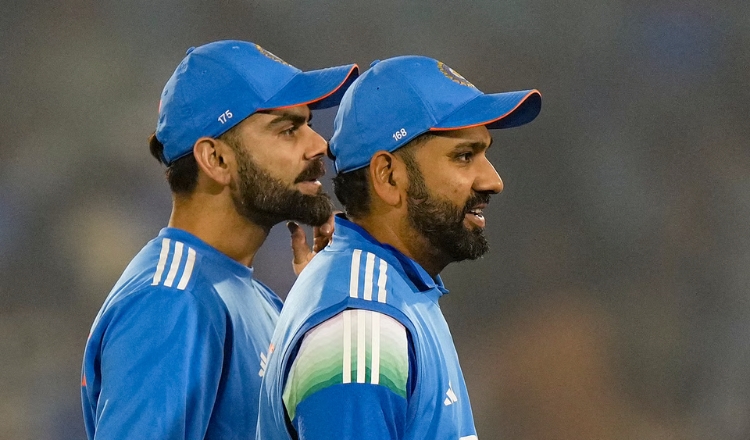
New Delhi — The Board of Control for Cricket in India (BCCI) is planning a thorough review of its central contract list in its Apex Council meeting set for December 22nd 2025. The meeting, which is to be held online will focus on the grading process and retention of cricketers in India’s contract for the upcoming cycle. Senior officials said that important changes are being considered and could include changes to the contract grades of the top cricketers Virat Kohli and Rohit Sharma.
Central contract lists, that lists the annual retainership amount and grade classifications, plays an important role in defining a principal player group for all formats. The forthcoming review is likely to be focused on aligning the contract grades with participation patterns in the format and workload management performance throughout the current evaluation period.
Senior Stars Are Likely to be ejected from Class A+
In internal discussions with the board the Kohli as well as Rohit are likely to be moved out of into the Category A+ which is the highest level of the retainership system -which is the Grade A category for the next year. If the change is implemented, it will decrease the annual retainer of seven crore to five crore. Although the board hasn’t released any official statement however, several officials who are who are involved in the preparations have stated that the change is being seriously considered.
The A+ grade is for players who have a consistent performance across all formats during the course of the season. In the past, this category has been reserved for cricketers who are integral to India’s Test ODI or T20I campaigns. Both Kohli and Rohit having retired from different formats The panel’s committee for evaluation is examining their eligibility to play in the top class.
The Reduced Involvement Across Formats is the key driver
One of the primary motives behind the possible shifting of grading is the lower involvement in the format of two players who are senior. The two players Kohli and Rohit have opted to leave Test cricket as well as T20 International cricket earlier this year, and have limited their participation with playing in the ODI setup. Because they are part of the A+ classification focuses on the accessibility of all formats, their diminished work load has had a direct impact on the evaluation process.
BCCI contract policy has historically given a significant weightage to Test cricket, as it is the format requires the highest athletic and psychological endurance. Test players who regularly play in Test matches typically play more days of cricket and are more likely to be retained for longer. In a move away from long-running formats, both players have drastically reduced their participation in games which has led to a reassessment of their grade.
BCCI’s Central Structure for Contracts and Retainership Framework
This BCCI annual contract is split into four levels:
- Grade A+ (Rs 7 crore)
- Grade A (Rs 5 crore)
- Grade B (Rs 3 crore)
- Grade C (Rs 1 crore)
Retainers are paid out in addition to match fees, which differ between formats. Players are paid Rs 15 lakh in a test match and six lakh for an ODI and three lakhs for the T20 International. Retainerships are meant to pay players for regularity and availability throughout the year regardless of the number of matches played.
The contract revision usually covers an entire year that is evaluated according to performances, workload, injury management, and participation in international and domestic cricket. The players must make an aforementioned minimum number of appearances or make an outstanding contribution to at least one format in order to be considered to be considered for inclusion.
Evaluation Criteria in Contract Decision-Making
The review process is governed by a number of criteria. Officials who have been familiar with procedure said that the committee is able to consider various criteria in determining players’ grades. This includes:
- Format Participation Formats that support two or more formats are given more preference.
- Efficiency: Sustained excellence across matches within a particular cycle can affect the allocation of grades.
- Availability: Frequent breaks, injuries, or format-specific absences impact grading.
- National Cricket Play: When not on national duty, players are required to take part in domestic tournaments like such as the Ranji Trophy or Vijay Hazare Trophy.
- Team Workload and Role: Leadership responsibilities and match-day duties are also assessed.
The next evaluation is likely to heavily depend on participation figures from October 2024 through September 2025. This is the standard assessment period that was used during the current cycle of contracts.
The previous contract cycle and Circumstances that Change
In the list of contract players released on April of 2025 in April 2025. Both Kohli as well as Rohit were put in the category A+. They were placed alongside key all-format contributors like Jasprit Bumrah as well as Ravindra Jadeja. While each player was active in the first part of the year however, their decision to resign from various styles later changed their participation rates.
The Apex Council’s forthcoming examination will be taking the entire year into consideration, including the period after the format’s withdrawals. Board officials have concluded that their ODI-only jobs are not in line with the requirements for eligibility that are required for A+ class, leading to the possibility of a change into Grade A.
The Rise of Shubman Gill Adds Dynamic to Contract Discussions
One notable change on the contract scene is the rapid rise of Shubman Gill. The young batsman who currently leads India on white-ball format, and continues to be a prominent player during Test matches, is now emerging to be one of the country’s key figures across all formats. His consistently consistent performances and availability across formats make him a strong candidate for possibility of being elevated up to an “A+” class on the list of players to watch.
Gill’s leadership role in T20Is and ODIs, along with his role in the setup for Tests, has made him one of the most prominent players in the transition period of India. The possibility of his promotion is a sign of the changing generation that is happening within the national team which sees younger players being given more responsibility.
The impact of changes to contracts on the Broader Team Structure
The possibility of grading revisions to Kohli as well as Rohit is a part of a larger restructuring the BCCI is working on to ensure the contract system is reflected in the roles of players accurately. The board is increasingly insisting on the use of performance-based grading and the need to reward players that have high levels of availability across different formats.
With India getting a new calendar of multi-formats that will include various Test series. Limited-overs tournaments as well as ICC events The BCCI is putting a renewed emphasis on recognizing players who have the most weight.
Contracts also serve as a way to keep players active on local cricket. In the last year, it has been repeatedly asked seniors to play the domestic circuit when they are they are not playing for national duties This could affect future grading strategies and strategies.
women’s central contracts also in Agenda for the Meeting Agenda
Alongside reviewing the men’s contracts, BCCI Apex Council will also review the list of central contracts of the women cricketers of India. The board is contemplating the possibility of structural changes to contracts as well as fee for matches as part of a continuous effort to strengthen the financial structure for women’s cricket.
The debate could also be a discussion of increasing the number of female contracted players, reevaluating retention and grades as well as making match fees more in line with the changing international standards. Officials have stated that they are working on improvement in the women’s domestic structure are also on the agenda for the meeting.
Revised Contract List to be Released after Apex Council Approval
The process for assessing contracts will continue until the last review is scheduled for December 22. After approval from the Apex Council the BCCI will likely to release the latest list of players contracted by the closing date of December. The updated list will establish the amount of retainership, grade allocations, and the overall structure that will be used throughout the following year’s cycle.