
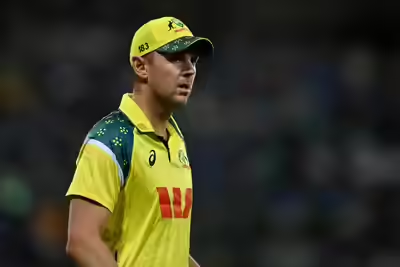
The preparations of Australia for their participation in the ICC Men’s T20 World Cup 2026 have suffered an enormous blow following the official announcement of the retirement of speed bowler Josh Hazlewood from the event due to ongoing injuries the officials announced on Friday 6 February 2026. The decision was made just a few days before the prestigious global event which is co-hosted by India and Sri Lanka — gets going, and is the beginning of a new time for Australia’s renowned speed attack.
Hazlewood 35, who is been suffering from ongoing Achilles and hamstring injuries which first recurred in the Sheffield Shield match in Australia’s domestic league in the last quarter of. Despite his long-running rehabilitation and initial expectations that he would get back to full fitness by the final stages of the competition, selectors concluded that the idea of advancing his rehabilitation program was a significant risk to his well-being and his performance.
Cricket Australia announced that Hazlewood is not expected to be replaced immediately in the team the selectors are citing sufficient protection for the team’s first matches. Selector for the national team Tony Dodemaide explained that the choice was made following thorough consultation with medical personnel and coaches and they agreed that having Hazlewood back too quickly could result in further aggravation of the injuries. “We believed that Josh could be fully recovered before when the stage for Super Eights was over,” Dodemaide said. “But the latest evidence suggests that he’s a little distance away and that accelerating the pace of his training is at risk. chance of risk.”
Hazlewood’s absence does not only affect the Australian World Cup campaign but also represents a change in the team’s bowling arsenal. The first time in 2011’s the 2011 ODI World Cup, Australia will be playing in a major ICC competition without of the legendary pace trio comprising Mitchell Starc, Pat Cummins and Hazlewood. Starc has retired after a year of T20 International cricket last year as did Cummins, and Cummins was dismissed earlier this week due to an ongoing back injury.
“Big Three.” The “Big Three” comprised the backbone of Australia’s fast-bowling team for over a decade they played key roles in a variety of ICC events, and contributing to the country’s dominance across formats. Their absence collectively highlights the issues that lie ahead for Australia in its quest to maintain its title in the most compact version of the sport.
Australia’s team, led by Captain Mitchell Marsh, will now be relying on a dwindling selection of frontline fasts for its first fixtures in Group B, which comprises games with Ireland, Sri Lanka, Oman and Zimbabwe. All-rounders Xavier Bartlett and Ben Dwarshuis currently are the only skilled fast bowlers who can be assured of selection prior to the start of the tournament. Nathan Ellis is not expected to be available for the opening games, as he is still in recuperation from a hamstring strain.
Due to the diminishing seam-bowling facilities, selectors and managers of the teams are likely to put more focus on spin options as well as bowling all-rounders. A spinner Adam Zampa, who was confirmed fit to play, will be expected to play a major part in Australia’s bowling strategy and especially when the subcontinent is a spin-friendly environment. All-rounders such Marcus Stoinis and Cameron Green may also be called upon to play to the bowl, offering an important flexibility to balance the team.
Australia’s road towards winning the T20 World Cup award was already fraught with difficulties due to a mixed start-up for the event, which included the recent three-point T20 series defeat against Pakistan. Another blow is losing Hazlewood’s knowledge and experience especially in high-pressure environments will test the strength and flexibility of the team.
Cricket Australia has yet to announce the replacement for Hazlewood however, this suggests that the choice will be in accordance with team needs as the tournament advances. The travel reserve Sean Abbott remains in the team and may be considered for a move to the 15-man main roster should it be needed.
Hazlewood famous for his control, precision and ability to cope under pressure, has not been in competitive cricket since November. He was unable to participate in the Australian Ashes game due to injuries. His absence, along with Cummins continuing recovery, and the retirement of Starc, marks an abrupt shift in Australia’s bowling environment in the lead-up to the World Cup.
The news has generated a an extensive discussion between cricket analysts and players and many have noted the end of a storied period within Australian cricket. The team is preparing to play Ireland at Colombo on the 11th of February, the focus shifts to what the current squad can do to adapt and if emerging bowlers will be able to fill the gap that their predecessors left behind.